The La Cruz Approach
 The
La Cruz Project has developed an approach that has never been used before. The
focus is on helping the ejidatarios reforest their lands and to develop income
and to reduce the pressure the oyamel forests that the monarchs need for their
overwintering sojourn. In four years, there will be income from the sale of
pines and oyamels that are planted for Christmas trees. Subsistence wood for
firewood and charcoal will be available in five to ten years. After ten years,
thinning of the trees will provide lumber for poles and fence posts. In
seventeen to twenty years, the reforested areas will be logged. During this
time period, more ejido lands will be planted and new forests will be created.
The ejidatarios who have committed themselves to reforestation will be receiving
the benefits of a continuing source of income from their new forests. They also
will not have to walk long distances into the monarch sanctuaries each day to
get their firewood.
The
La Cruz Project has developed an approach that has never been used before. The
focus is on helping the ejidatarios reforest their lands and to develop income
and to reduce the pressure the oyamel forests that the monarchs need for their
overwintering sojourn. In four years, there will be income from the sale of
pines and oyamels that are planted for Christmas trees. Subsistence wood for
firewood and charcoal will be available in five to ten years. After ten years,
thinning of the trees will provide lumber for poles and fence posts. In
seventeen to twenty years, the reforested areas will be logged. During this
time period, more ejido lands will be planted and new forests will be created.
The ejidatarios who have committed themselves to reforestation will be receiving
the benefits of a continuing source of income from their new forests. They also
will not have to walk long distances into the monarch sanctuaries each day to
get their firewood.
Another goal of the La Cruz Project is to keep that portion of the trees'
value that is being lost to commercial lumber operations As the ejidatarios see
the value of growing and using their own forests, it is expected that they will
realize that they have the skills needed to build their own lumber mills and,
eventually, their own wood product industries. The full value of the trees,
and more, will be kept in the communities. There is an ejido near Santa Clara
del Cobre, Tzintzun, that has done exactly that. Jose Luis Alvarez has been
working with this ejido for a number of years and has been providing them
seedlings from his nursery, Vivero La Cruz.
In 1997, the La Cruz Project and the ejidatarios made a start. Over 7000
oyamel and pine seedlings were planted by the La Cruz Project and the
ejidatarios at the community or ejido of El Rosario. Five land owners came
forward and were willing to accept the risk of not using their land for crops
and grazing. They decided to plant the 7,000 oyamel and pine seedlings on 3.5
hectares or over 7 acres that they owned. When you are poor and you don't know
whether you are going to have any food from day to day, this is a bold decision.
The trees were made possible as a result of the initial contributions made by
individuals in the United States. It was a small start, a very small start, but
it was significant. For the first time the people who have been using a
critical habitat and threatening its continued existence have been given an
alternative. The ejidatarios had to make a very tough decision. They decided
to take a portion of their individual ownership and stop growing corn and oats
and grazing their cows and sheep. This is not an easy decision after trying to
survive for generations.
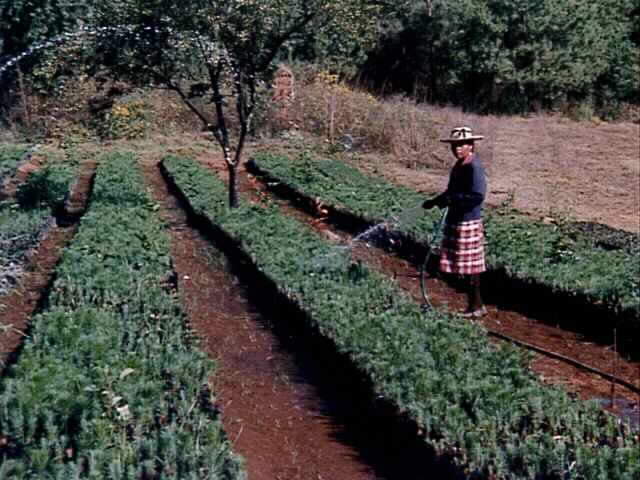
Something very important happened in 1998. Twenty ejidatarios came forward
and wanted to plant the 40,000 seedlings that the La Cruz Project had been able
to propagate starting in September of 1996. If there had been more trees, they
would have been planted. The goal for 1999 is to propagate more than 125,000
oyamel fir and pine seedlings to be planted in the overwintering areas during
the rainy season next July.


 The
La Cruz Project has developed an approach that has never been used before. The
focus is on helping the ejidatarios reforest their lands and to develop income
and to reduce the pressure the oyamel forests that the monarchs need for their
overwintering sojourn. In four years, there will be income from the sale of
pines and oyamels that are planted for Christmas trees. Subsistence wood for
firewood and charcoal will be available in five to ten years. After ten years,
thinning of the trees will provide lumber for poles and fence posts. In
seventeen to twenty years, the reforested areas will be logged. During this
time period, more ejido lands will be planted and new forests will be created.
The ejidatarios who have committed themselves to reforestation will be receiving
the benefits of a continuing source of income from their new forests. They also
will not have to walk long distances into the monarch sanctuaries each day to
get their firewood.
The
La Cruz Project has developed an approach that has never been used before. The
focus is on helping the ejidatarios reforest their lands and to develop income
and to reduce the pressure the oyamel forests that the monarchs need for their
overwintering sojourn. In four years, there will be income from the sale of
pines and oyamels that are planted for Christmas trees. Subsistence wood for
firewood and charcoal will be available in five to ten years. After ten years,
thinning of the trees will provide lumber for poles and fence posts. In
seventeen to twenty years, the reforested areas will be logged. During this
time period, more ejido lands will be planted and new forests will be created.
The ejidatarios who have committed themselves to reforestation will be receiving
the benefits of a continuing source of income from their new forests. They also
will not have to walk long distances into the monarch sanctuaries each day to
get their firewood.